Showing posts with label Health. Show all posts

Friday, October 19, 2012

Does a Healthy Diet Prevent Chronic Disease?

Excerpted from the American College of Preventive Medicine, Jonathan Berz, MD, MSc


Poor diet is a major contributor to the leading causes of chronic disease and death in the United States, including coronary heart disease, diabetes, hyperlipidemia, and stroke.

Although it is true that the obesity and chronic disease epidemics have complicated origins, the contribution of our current society's easy access to highly processed foods and low consumption of fresh and whole foods cannot be overemphasized. At the turn of the millennium, the Centers for Disease Control and Prevention's Behavioral Risk Factor Surveillance Survey showed that less than 25% of Americans consumed the recommended amount of fruits and vegetables and equally few were as physically active as was recommended. More recent studies have not shown much improvement in the low prevalence of healthy lifestyle practices.

The DASH Diet

The Dietary Guidelines for Americans were updated in 2010 and the DASH diet was highlighted as a guideline for healthy eating.[9] DASH has as its core the increased consumption of fresh fruits and vegetables and low-fat dairy products. Fruits and vegetables are important because of the low-caloric and high-nutrient density of such foods and the satiating effects of fiber. Low-fat dairy consumption provides calcium that is needed for bone health and other health outcomes. Other components of DASH include nuts, legumes (dried beans and peas), whole grains, and limiting salt and added sugar intake.

Nuts are rich in beneficial mono- and polyunsaturated fats and are high in fiber and protein. Legumes are a rich source of protein as well as fiber, and lean meats are important sources of protein. Grains provide an important source of energy and should be consumed mostly as whole grains, which will increase fiber consumption. The DASH diet also limits salt to 2300 milligrams per day and added sugar intake to 5 tablespoons per week for the average 2000-calories/day diet. Table 1 shows the recommended intakes of each of these food groups in servings per day for those who consume 2000 calories per day.

DASH Diet Food Group Servings for a 2000-Calories-Per-Day Diet
Food Group Target Serving Examples of 1 Serving
Low-fat dairy 2-3/day 1 cup milk or yogurt
Grains (mostly whole) 6-8/day 1 slice bread
1 oz dry cereal
1/2 cup cooked rice, pasta, or cereal
Lean meats, poultry, fish ≤6/day 1 oz cooked lean meat, poultry, or fish
1 egg
Nuts/seeds/legumes 4-5/week 1/3 cup or 1 1/2 oz nuts
2 Tbsp peanut butter 2 Tbsp or 1/2 oz seeds 1/2 cup cooked legumes
Fruits 4-5/day 1 medium fruit 1/4 cup dried fruit 1/2 cup fresh, frozen, or canned fruit 1/2 cup fruit juice
Vegetables 4-5/day 1 cup raw leafy vegetables
1/2 cup cut-up raw or cooked vegetables
Adapted from the 2010 Dietary Guidelines for Americans.

Tuesday, September 18, 2012

Foundation For Good Health

This article is courtesy of Fullerton Cardiovascular Medical Group


A balanced diet of whole, natural foods is the foundation for good health. Learning how to make better choices at home, in the grocery store, and when dining out is a huge, important step. Be proud if you've started to move in that direction. To take it one step further, consider adding supplements to your daily routine. There are countless supplements, and many are unnecessary or even harmful. Take care and always talk with your doctor before starting a new regimen.

Here are a few you can count on:
  • Probiotics. It turns out that thousands of tiny organisms or "probiotics" needed for good health live in your gut/belly. They help us digest and absorb our food, support our immune system, prevent disease, and treat or stave off diarrhea, gas, and other bowel problems. In addition to supplements, you can get probiotics from a fiber-rich diet full of vegetables, beans, seeds, yogurt, and whole grains.
  • Omega-3s. Omega-3 fatty acids, or essential fatty acids, are necessary for health but your body can't make them. Research suggests that they may decrease cholesterol and blood pressure, reduce the risk for heart disease, diabetes, and some cancers, and help treat depression and anxiety. You can get omega-3s from cold water fish such as salmon, tuna, and halibut, as well as other seafood like algae and krill, some plants, and nut oils, and supplements may contain any of these. If you get a fish oil supplement, it should have both EPA and DHA (eicosapentaenoic acid and docosahexaenoic acid).
  • Vitamin D. In addition to keeping your bones strong in partnership with calcium, vitamin D is essential for mood and premenstrual syndrome (PMS) improvement, immune system boosting, and blood pressure lowering. Vitamin D is even thought to help prevent cancer, diabetes, and heart disease. In addition to foods like salmon, tuna, milk, and eggs, you can take in vitamin D from direct sun exposure. Most people should take a supplement though, and usually in the form of vitamin D3.

Tuesday, September 11, 2012

All About Sugar

Sugar. The ubiquitous sweet substance has positive associations for most of us. Birthday cake, lemonade in the summer, chocolate on Valentine's Day - these are just a few of the many sugar-related traditions that bring up happy memories. But what's the real story?

When you eat, food molecules are broken down into a simple sugar called glucose, which fuels your cells and gives your body energy. But most of the time when we talk about sugar we are referring to added sugar. This is sugar that is added to foods and drinks as a preservative or to provide flavor. These types of sugars - such as sucrose (white table sugar) and high fructose corn syrup (a processed combination of sugars and corn syrup) - are derived from various plants, especially sugar cane and sugar beet. They increase your blood glucose immediately, give you a quick boost of energy, and then cause you to crash.

Consuming a lot of these sugars also contributes to extra calories in your diet and can set the stage for a variety of health problems. Consider that in 1700, the average person ate about four pounds of sugar per year, while today it is estimated that half of all Americans eat one-half pound of sugar per day.

Too much sugar can lead to: Tooth decay. Sugar allows bacteria to grow in your mouth, which causes cavities. Poor diet. If you are filling up on sugary foods and drinks, you are likely missing out on important nourishment from fruits, vegetables, whole grains, and lean proteins. Weight gain. One of the biggest precursors to obesity is sugar overload, especially from sodas. Cardiovascular issues.

Sugar increases your blood fat levels, which can lead to heart disease. If you have a sugar craving, have a piece of fruit. The natural sugar in fruit (fructose) is combined with good nutrients and fiber, so it doesn't have these negative effects in the body. Limit daily sugar intake to 40 grams at most. Be careful with sugar substitutes, too. Try natural sweeteners such as honey, maple syrup, and agave.

Moderation is key This article is courtesy of Fullerton Cardiovasculae

Wednesday, July 11, 2012

Skin Care Tips

Wash with mild cleanser & warm water no more than 2x/day. Gently massage skin with circular motions. Don’t scrub. Over-washing can cause irritation, inflammation and dehydration. 

Don't squeeze. Pimples are caused by sebum, dirt and bacteria in a pore festering. Squeezing pimples can push infected material further into the skin, leading to more swelling and redness, and even scarring. Treat pimple with topical products from a reputable Esthetician and get regular facials with extractions from an Esthetician.

Don't touch with your hands or objects like telephones (do you know where your cellphone has been?). Touching the face can spread bacteria and other organisms causing inflammation and irritation.

Clean glasses (including sunglasses) often to keep oil and bacteria from clogging and infecting pores. This is especially true for those of you who put your sunglasses in your hair.

 . . . . . . more to follow

Thursday, June 28, 2012

Monday, March 5, 2012

Can Stress Cause Acne?

Although stress does not directly cause acne, it can aggravate acneic conditions in those who are prone toward acne. Stress increases cortisol. And, long term stress keeps the cortisol levels elevated for long periods of time. Cortisol is a hormone released by the adrenal gland and it:

* Is a diuretic dehydrating the skin.
* Increases blood sugar.
* Weakens the the immune system.
* Creates inflammation of the skin and other organs.

Common causes of adult Acne are:

* Heredity
* Hormones
* Stress (see above)

In my practice, an acne facial consists of deep cleansing the skin, addressing the infection and inflammation and soothing the soul to calm your stress. It's more than just an acne facial.
Schedule Now

Wednesday, February 29, 2012

Reflexology and Gallbladder Warning Signs

Did you know that if you have pain on the right upper back/ shoulder area with pain under your right rib cage... Could be your gallbladder and you should get it checked. In Reflexology, the gallbladder is a small area on the arch of the right foot, between the fourth and pinky toes.

Wednesday, February 15, 2012

The Heart Remembers

Beating 100,000 times a day, this muscle pumps oxygen, food-derived nutrients, hormones and immune cells throughout every square inch of our bodies. By now, most of us know that a healthy diet (a controversial subject in itself), regular exercise, preventative dental care and plenty of fresh air support a healthy cardiovascular system; and that smoking, obesity, acidic blood, noise pollution, exposure to bisphenol A (BPA) and a sedentary lifestyle don’t.
  • There is no time in utero that the heart starts to beat. The cells beat from the start. As the cells multiply to create the cardiovascular system, they take their cues on how to beat, at what rate, etc. from the mother’s heart. So, when did the mother’s heart begin to beat? If every cell was beating before it was a heart, then how could there be a single moment it became a heart? The heart (and arteries and veins attached), it turns out, is a circulation system with no beginning and no end. Perhaps that is why the Chinese refer to the heartbeat as the cosmic beat.
  • The heart remembers. Modern medicine can now confirm that those early Egyptians were right. The heart has its own intelligence and remembers. Much has been written about transplant recipients receiving not only an organ, but the personality traits, temperament and memories of their donor.
  • The Chinese pictograph for the word “busy” is composed of two characters: “heart” and “killing”. Hmm…
  • That last one reminds me of a quote from Lily Tomlin that a friend shared today: “For fast-acting relief, try slowing down.”
Excerpted from Karen Ball
 

Saturday, January 21, 2012

What Are Free Radicals and Antioxidants?

Antioxidants are chemicals that break down or neutralize the damaging effects of free radicals - chemicals produced as a byproduct of normal cellular metabolism. Under normal circumstances, there is a balance between the rate at which free radicals are produced and the rate at which they are eliminated by the action of antioxidants. Free radicals are destructive in that they cause oxidative damage to tissues - essentially causing tissues to rust like a piece of iron left outside in the weather. They damage proteins, fat and even our DNA. In fact, damage to our tissues by free radicals is thought to underlie the process of aging, a theory first described by Dr. Denham Harmon in his "free radical theory of aging" proposed in 1956. Indeed, Dr. Harmon laid the groundwork for the whole antioxidant industry when he demonstrated that free radicals are "quenched" by antioxidants.


*Note: excerpted from an article by David Perlmutter, MD, FACN, ABIHM Free Radicals: How They Speed the Aging Process originally published in The Huffington Post on January 25, 2011.

Monday, January 16, 2012

Leg or Foot Cramps? Here's Some Simple Do It Yourself Relief

Here are a couple remedies for foot or leg cramps:

For some leg/foot cramps the muscle needs to flex such as with night leg cramps. Keep a long scarf or cord at bedside. When the cramp occurs, lie on your back and bend the opposite leg, loop the scarf or cord around the arch of the foot that is cramping and slowly pull up with both hands flexing the foot and the whole leg. Hold for about 1/2 a minute and release. Do this a couple of times and the cramp normally vanishes.

On the top of the foot between the ankle bones you will find a little hollow. Press there.
If  the cramps are occurring often you may need to see a health professional.

Interested in more about Reflexology? Click here.

Friday, October 22, 2010

Your Skin and Sleep

Good sleep = good skin
While you are in a deep sleep, your body is repairing itself - this includes your skin. Not getting enough quality sleep puts the body, including the skin, into stress.

 Cortisol (hydrocortisone) is released by the adrenal gland in response to stress.

A little cortisol goes a long way. Under prolonged stress cortisol:

  • Counteracts insulin contributing to hyperglycemia.
  • Decreases the collagen in the skin by ten times.
  • Inhibits sodium loss.
  • Disrupts the body's natural pH.
  • Causes water retention.
  • Weakens the immune system.
  • Lowers bone formation.
  • Impairs memory and learning.
Getting a good night's deep sleep can reverse the impact of those stressful days. And, before bedtime be sure to wash your face and use a good nighttime moisturizer so that you will wake up fresh and hydrated.

Pleasant dreams.

Thursday, June 24, 2010

Smoking and the Puckered Pout

So you smoked or are smoking and are noticing those little tiny lines above your lip. Some of the lines are the natural result of all those years of pursing those lips. However, the added pursing of the inhale, the heat and chemicals from the smoke take an additional, and in some cases dramatic, toll. The skin of the upper lip is 1/3rd as thin as the rest of the facial skin (excluding that around the eyes).

There are at least 12 "expression" muscles that are attached to the dermis are around the lips. Besides frying that upper lip drying it out and poisoning it; you've trained the muscles to contract further wrinkling and creasing the skin.

What to do? Things that can help from your esthetician:

  • light microdermabrasion
  • microcurrent
  • hydrating treatments that include hyaluronic acid
  • An SPF30 sunscreen with a physical block (zinc oxide and/or titanium dioxide)
  • a clear waxy lip liner can help to keep lipstick from bleeding up the creases
To just have the lip treated would run around $25 - $50 each treatment plus take home products to continue the treatment.

Things that can help for more severe cases:
  • hyaluronic acid fillers (Restylane, Juvederm, etc.)
Dermal fillers run about $400 per treatment.

Saturday, June 19, 2010

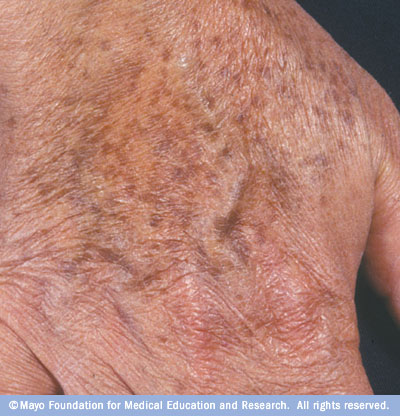
Is That Youthful Fun Showing Up In Undesired Ways?

Age spots develop in many places on the body particularly the tops of the shoulders, upper back, chest and back of hands. They are generally caused by the sun exposure of our youth. 
Remember that burn you had on your shoulders, back or chest? Well, there it is again!
The backs of our hands are constantly exposed to the sun as well as the magnified sun in the car while we drive.
Other signs of sun damage in these areas including the backs of the hands are:
  • Deep wrinkles
  • Dry, rough skin
  • Fine red veins
  • Thinner, more translucent-looking skin
Although not something we want, age spots are generally harmless. Have a doctor check evaluate any that become dark or have changed appearance.

To get rid of or at least minimize the spots there are pigment lightening gels, microdermabrasion, peels and for extreme cases lasers. All of these remedies will target the melanin in the brown spots to fade or remove them.

To prevent age spots, prevent them from getting worse, and particularly after we've faded them - use a good SPF 30 with a physical block like zinc oxide and/or titanium dioxide. And, you might want to consider wearing gloves while driving.

Sunday, June 13, 2010

More on Botox

As reported in the OC Register today - Dr. John DiSaia of San Clemente and Anaheim says, there is no proof that using Botox over any period of time is a guarantee that you won't wrinkle in those areas. He says, "This would be very difficult to prove. Whether or not aged tissue would form some sort of wrinkle even with less activity may be more a matter of genetics than of use of a paralytic."

Plastic surgeon Dr. Joseph Cruise of Newport Beach says, "Certainly, permanent wrinkles can be avoided if there is no motion within the skin. The real cause of wrinkles, however, is not from our facial muscles getting stronger with age. Facial muscles are just like every other muscle in the body - they get weaker with age. Wrinkles occur with age because the facial fat that separates the skin from the muscles 'melts' away."

Doctor's agree that focusing on Botox as a wrinkle-fighter misses the most important causes of wrinkles. "Stopping cigarette smoking and limiting sun exposure may be more effective and would certainly be cheaper," says Dr. DiSaia.

I will add that adding monthly facials can do wonders for keeping the skin clean, increasing circulation and moisture. Try a microcurrent facial at a fraction of the cost of Botox for healthy skin, encouraged collagen and elastin replacement and amazing facial rejuvenation.

Wednesday, June 2, 2010

A Happy Attitude Could Change Your Longevity

Dr. Hilary Tindle and a team from the Women's Health Initiative were interested in finding out if optimism (positive future expectations) and cynical, hostile attitudes toward others are related to coronary heart disease and mortality (death) in postmenopausal women. Guess what!! Women who scored at the top of the optimism scale had lower rates of heart disease and total mortality that pessimists, The most cynical, hostile women also had higher rates of heart disease and death.

Also, in terms of cancer, the most cynical, hostile women had a higher risk of cancer-related mortality and total mortality,

So the conclusions were that optimism and cynical hostility are both associated with important health outcomes.

So ladies, let's get those sunny dispositions rolling.

Monday, May 31, 2010

Kreamy Soaps Pine Tar


Pine Tar Soap, is also known as the Medicinal Bar. Pine Tar Soap contains  Lavender Jojoba Bean Oil. Using it on the face (yes, I said face) and body with problems such as acne, psoriasis, eczema, rashes and even on tattoo irritations can soothe and resolve these issues. In face, there are reports that Kreamy Soaps Pine Tar has helped folks out with poison oak. Pine Tar could just give you the healthy skin you were born to enjoy! You don't have to have sensitive skin to enjoy our Pine Tar, anyone can use it. Pine Tar also makes for a great hair wash. After washing your hair with any of our Kreamy Soaps bars we recommend rinsing with Bragg's Apple Cider Vinegar, giving your hair and scalp a real lift. Contact me, try it out. 

Tuesday, May 25, 2010

Botox Can Add Wrinkles

In a recent article in The Orange County Register columnist Colin Stewart interviewed several cosmetic doctors about the new wrinkles appearing on famous and Botoxed faces. Seems that the rules kick in "for every action, there's an equal and opposite reaction". That is to say that if you paralize one set of muscles other muscles kick in to help out their paralyzed buddies thus creating what is called adjunct wrinkling. Now we're seeing "bunny lines" that start at the sides of the bridge of the nose and end at the outer edge of the eyes. So now the "bunny lines" muscles need Botox.

I'm nether here nor there about Botox. However, I have seen some miraculous softening and rejuvenating effects on my clients who receive regular Microcurrent rejuvenating facials for far less cost and no injected botulism. An added benefit to the Microcurrent rejuvenating facial is that your entire face is lifted and the skin is revitalized.

Thursday, February 25, 2010

Retin-A Creator

Dr. Albert Kligman, a dermatologist and the developer of Retin-A and Renova, has died.

Dr. Kligman had been on the faculty of prestigious University of Pennsylvania for 50 years.

A prolific researcher, Dr. Kligan was first to describe the human hair-growth cycle (interesting information for those of us who need waxing), investigated the pathogenesis of acne vulgaris, identified the effects of sunlight on the skin (that's how we know the bad things sun does to our skin), and coined the terms photoaging and cosmeceuticals. He also disproved that chocolate promotes acne and other myths.

Tretinoin (Retin-A) is a derivative of vitamin A and originally was too aggressive for the skin until Dr. Kligan refined it. He patented it in 1967. Along the way he discovered the tretinoin reduced wrinkles - thus we have Renova.

Rest in peace Dr. Kligan, we'll miss your discoveries.

Monday, June 15, 2009

Essential Oil Blends for Your Pet

Young Living essential oils has created some oil blends that can be helpful in your pet's health.
Remember to dilute the oils - 1 - 3 drops per ounce of jojoba or grapeseed oil.
  • Thieves is perfect for attending to minor skin and dental issues.
  • Melrose when used in conjunction with R.C. and Raven, Melrose provides respiratory support. It can also be used on minor skin issues if Thieves cannot be tolerated.
  • R.C. is ideal for respiratory and urinary tract support. R.C. is practical for cats that require bladder fortification, which does not respond to conventional therapy. Pair with Raven for added support.
  • Raven is also utilized for respiratory and urinary tract support, Raven is more powerful than R.C. Combining these oils are highly effective.
  • Di-Gize is wonderful for the gastrointestinal system. Add nutmeg and ginger essential oil for additional support.
  • Peace & Calming for stress, fear or anxiety. Peace and Calming can be used to calm a pet. If the pet is injured, Peace & Calming can relax the animal enough to administer other treatments. This blend can also be used on cats who are resistant to other forms of treatment for urinary problems or excessive grooming resulting from stress.
  • Purification is useful for external parasites such as fleas, ticks and mosquitos.
  • M-Grain provides relief from head discomfort resulting from sinus pressure.
  • PanAway is valuable relief for the discomfort and relaxing the muscles, ligaments, and tendons. It works particularly well for pets with osteoarthritis. Using a moist towel over the area increases the effectiveness of the oils.
  • Relieve It is especially beneficial for relieving discomfort and can be alternated with PanAway.

Essential Oils in the Garden

I became interested in essential oils because of love of good fragrance. Soon I learned that there was more to essential oils than good clean smell. 
*There are the amazing health benefits of these oils. Essential oils can help with things like headache, burns, upset stomach.
*Are you aware that there are oils that you can use in cooking. Try adding a drop of an herbal oil to that recipe instead of the herb in a bottle.
*My newest discovery - essential oils in the garden. Essential oils can help rid the garden of pests and weeds as well as make a healthy compost. Spring is the time to rekindle our relationship with the garden. Whatever you're growing it's important, whenever possible, to keep harsh chemicals away from your plants. Harsh chemicals harm the environment and can be harmful to your family and pets. Here are some tips that can help you grow a beautiful garden with green essential oils. 1. For an effective bug repellent, fill a 24-oz spray bottle with water and add 2 - 3 drops of oregano, basil or thyme essential oil. To add zip to this green bug repellent, blend a clove of garlic and add to the solution with 2-tsp. insecticidal soap (add soap last). Spray this solution on or near infected plants. 2. Apply cinnamon essential oil as an herbicide to get rid of weeds. Take care to apply only to the weeds. 3. If you grow lavender, add the cuttings to the compost heap. Its a wonderful compost material and soil amendment.